

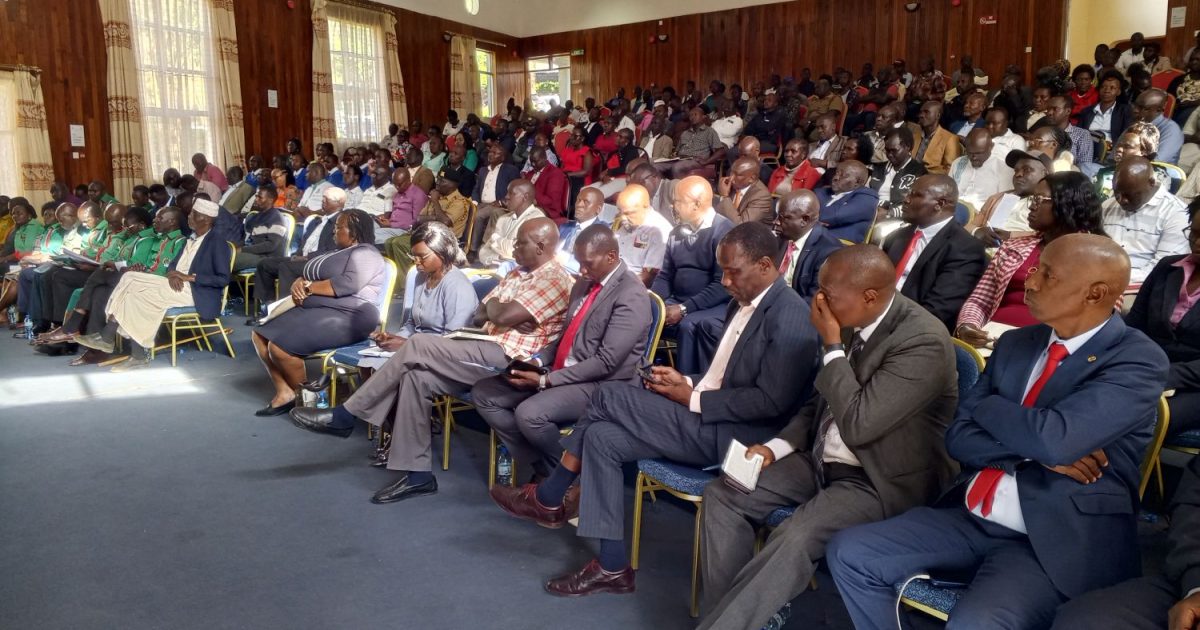
Education Stakeholders Push to Return ECDE Management to National Government.
Education stakeholders in Baringo County want Early Childhood Development Education (ECDE) taken away from county governments and handed back to the national government under the Teachers Service Commission (TSC) and the Ministry of Education. They made the demand during a public participation forum on six proposed education reform bills held at the Kenya School of Government, Baringo Campus, in Kabarnet town.
The forum was chaired by Baringo North MP Joseph Makilap, alongside fellow members of the National Assembly Departmental Committee on Education — Nabii Nabwera (Lugari), Peter Orero (Kibra), Mary Emase (Teso South) and Prof Phyllis Bartoo (Moiben). It formed part of a nationwide consultation exercise that Parliament has now extended to run until 2 October 2026, covering all 47 counties.
What stakeholders in Baringo are asking for
Kenya National Union of Teachers (KNUT) Koibatek Branch Executive Secretary Francis Bundotich led the push, accusing county governments — Baringo in particular — of mismanaging ECDE centres across the county’s 30 wards. He cited poor infrastructure, staff shortages and weak welfare support as evidence that devolved management has not worked for the youngest learners in the education system.
“Let pre-primary school be taken over from the county to the TSC and Ministry of Education so that it can be managed better alongside Primary and Junior School under a comprehensive model,” Bundotich said.
Parents’ representative Reuben Chepsongol, a former Bartabwa Ward MCA, raised a separate but related concern: affordability. He said many parents, particularly in Baringo’s lowland areas, struggle to meet peripheral enrolment costs and feeding expenses, which discourages children from staying in ECDE. He also argued that national management would improve teacher pay and end the delayed salary disbursements that county-employed ECDE teachers commonly report.
Makilap told the stakeholders to pursue the matter through the proper constitutional channels, noting that reversing devolution of a function is not a simple legislative fix.
Why this keeps coming up: the state of ECDE under devolution
Baringo’s complaints echo a pattern playing out in counties across Kenya. Since the 2010 Constitution assigned ECDE to county governments under the Fourth Schedule, teachers’ unions have repeatedly argued that pay, job security and professional standards vary too widely from one county to the next.
In several counties, ECDE teachers have gone months without salaries or remained on short-term contracts for years. In Murang’a County, for example, tutors employed since 2016 staged a demonstration in mid-2026 over unfair contract terms, reporting a gross salary of around KSh17,000 that drops to roughly KSh14,000 after statutory deductions — far below what primary school teachers under TSC earn for comparable qualifications. Similar disputes over unpaid or delayed salaries have surfaced in counties including West Pokot.
Baringo itself has taken some corrective steps recently. In June 2026, the county government converted 1,600 ECDE teachers to permanent and pensionable terms, ending years of contract insecurity, and in May 2026 it signed an agreement with Teach For Kenya to co-finance ECDE leadership fellows in the county.
These moves suggest the county is trying to address the same problems stakeholders raised at the Kabarnet forum — but Bundotich and others argue the fixes are inconsistent and too slow.
Read Also: Can a Private School Raise Fees Without Asking Parents? What the High Court Just Ruled
Who actually controls ECDE right now
The confusion over “who is responsible” is itself part of the problem. Under the current framework:
| Function | Who handles it |
|---|---|
| Recruitment, deployment and pay of ECDE teachers | County governments (under Section 38 of the Early Childhood Education Act, 2021) |
| Registration, discipline standards and professional conduct of ECDE teachers | TSC |
| Infrastructure, feeding programmes and resourcing of ECDE centres | County governments |
| Curriculum content and assessment standards | Ministry of Education / Kenya Institute of Curriculum Development (KICD) |
This split — county employment but TSC-linked professional oversight — is exactly what critics say creates friction. ECDE teachers can find themselves answerable to a county human resource code and the TSC Code of Conduct at the same time, while working alongside primary school colleagues employed and paid directly by TSC under noticeably better terms.
Has anyone tried to change this through the courts?
Yes, more than once, and it has not succeeded. A civil society activist, Stephen Chahasi Lumwaji, petitioned the High Court in October 2025 to declare Section 38 of the Early Childhood Education Act unconstitutional and compel TSC to take over ECDE recruitment directly.
Justice Roseline Aburili struck out the petition after TSC, the Council of Governors and the Attorney General argued that the same question had already been conclusively settled by the High Court in a 2016 case brought by KNUT.
The court found that, despite the 2021 Act being newer law, the petitioner was essentially asking for the same outcome the courts had already rejected: exclusive TSC control over ECDE staffing.
That ruling means the legal route to shifting ECDE employment to TSC is effectively closed for now, unless a genuinely new legal argument or a change in the law itself is brought forward — which is where the six reform bills, and Parliament’s own amendment powers, come in.
Read Also: Gatoto Primary School: High Court Summons KNEC CEO Over Exam Registration for 300 Pupils
Could Parliament simply move ECDE back to national government?
Not as easily as it might sound. ECDE is assigned to counties in the Fourth Schedule of the Constitution, and any change to which level of government performs a function must go through a full constitutional amendment process, not an ordinary Act of Parliament.
Under Article 255 of the Constitution, amendments touching “the objects, principles and structure of devolved government” cannot be passed by Parliament alone, however large the majority.
They must also be approved in a national referendum, in which at least 20 percent of registered voters in at least half of Kenya’s 47 counties take part, with a simple majority supporting the change. Moving ECDE from counties to the national government would very likely fall into this category, since it goes to the heart of what devolved government controls.
In practice, this means Makilap’s comment that changing the arrangement requires “two-thirds” of Parliament captures only part of the process. Even with the required parliamentary supermajority, a referendum would still be needed before such a transfer could take legal effect — a considerably higher bar than reforming ECDE through ordinary legislation.
Where the six education reform bills fit in
The Baringo forum was not a stand-alone event. It is one stop in a nationwide public participation exercise on six bills that Parliament’s Departmental Committee on Education, chaired by Tinderet MP Julius Melly, is running across all 47 counties before the extended deadline of 2 October 2026.
| Bill | What it proposes |
|---|---|
| Basic Education Bill, 2026 | Repeals and replaces the Basic Education Act (2013); gives legal backing to the “comprehensive school model,” under which ECDE, primary and junior school operate under one management structure |
| Tertiary Education, Placement and Funding Bill, 2026 | Creates a Tertiary Education Funding Authority (merging HELB, the Universities Fund and TVET Fund) and expands KUCCPS placement powers |
| Kenya National Educational Assessments Council Bill, 2026 | Replaces KNEC with a new body overseeing competency-based assessment |
| Pre-Service Education and In-Service Training Bill, 2026 | Reorganises teacher training and continuous professional development |
| Kenya National Qualifications Framework (Amendment) Bill, 2026 | Strengthens credential tracking and verification databases |
| Kenya Institute of Curriculum Development (Amendment) Bill, 2026 | Changes curriculum review processes and integrates special needs education into the CBC/CBE framework |
Read Also: Moi University Dress Code 2026: Full List of Banned Clothes
None of the six bills, as currently drafted, proposes transferring ECDE employment from counties to the national government.
The closest connection is the Basic Education Bill’s “comprehensive school model,” which would give legal backing to managing ECDE, primary and junior school under one structure — which is essentially the outcome Bundotich and KNUT Koibatek are calling for, though achieved through unified school-level management rather than a wholesale constitutional transfer of the ECDE function itself.
Whether that model resolves the pay and staffing disparities stakeholders are complaining about will depend on how the Bill defines authority over recruitment and remuneration once it moves past the public participation stage.
The Kenya Union of Post Primary Education Teachers (KUPPET) had earlier criticised the original two-week consultation window as too short for the public to properly interrogate bills of this scale, which contributed to Parliament’s decision to extend hearings to 2 October and add 16 more counties to the schedule.
What Baringo residents can still do
Public participation on the six bills remains open in the counties still on the schedule, and anyone unable to attend an in-person forum can submit a written memorandum to the Clerk of the National Assembly.
Kenyans who want ECDE reform reflected in the final bills — whether they support returning the function to national government or improving how counties manage it — should use this window rather than relying on informal advocacy afterward, since Article 118 public participation is the formal channel Parliament is required to consider before finalising the legislation.
Frequently Asked Questions
Is ECDE currently managed by counties or the national government?
County governments handle recruitment, deployment and pay of ECDE teachers. TSC handles their registration and professional discipline. Curriculum and assessment fall under the Ministry of Education and KICD.
Can Parliament move ECDE back to the national government on its own?
Not through an ordinary Act of Parliament. Because ECDE is assigned to counties under the Constitution’s Fourth Schedule, shifting it to the national government would likely require a full constitutional amendment, including approval in a national referendum, not just a parliamentary vote.
Do the six education reform bills transfer ECDE to TSC?
No. As drafted, none of the six 2026 bills transfers ECDE employment to TSC. The Basic Education Bill introduces a “comprehensive school model” that manages ECDE, primary and junior school together, which is close to what Baringo stakeholders want, but it does not by itself change who employs ECDE teachers.
Has anyone tried to force TSC to take over ECDE recruitment through the courts?
Yes. A 2025 petition seeking exactly that was struck out by the High Court in 2026, which found the matter had already been conclusively decided in a 2016 case.
When does public participation on the six bills end?
Parliament has extended the nationwide consultation to 2 October 2026, after initially running it from 14 to 25 September across 31 counties.
This article reports on statements made at a public forum and reflects the legal and legislative position as of 25 September 2026. Readers with views on the six bills can still submit memoranda to the Clerk of the National Assembly before the extended deadline.
Education Stakeholders Push to Return ECDE Management to National Government.
Follow Teachers Updates on Facebook, LinkedIn, X (Twitter), WhatsApp, Telegram, and Instagram. Get in touch with our editors at hello@teachersupdates.news.
