

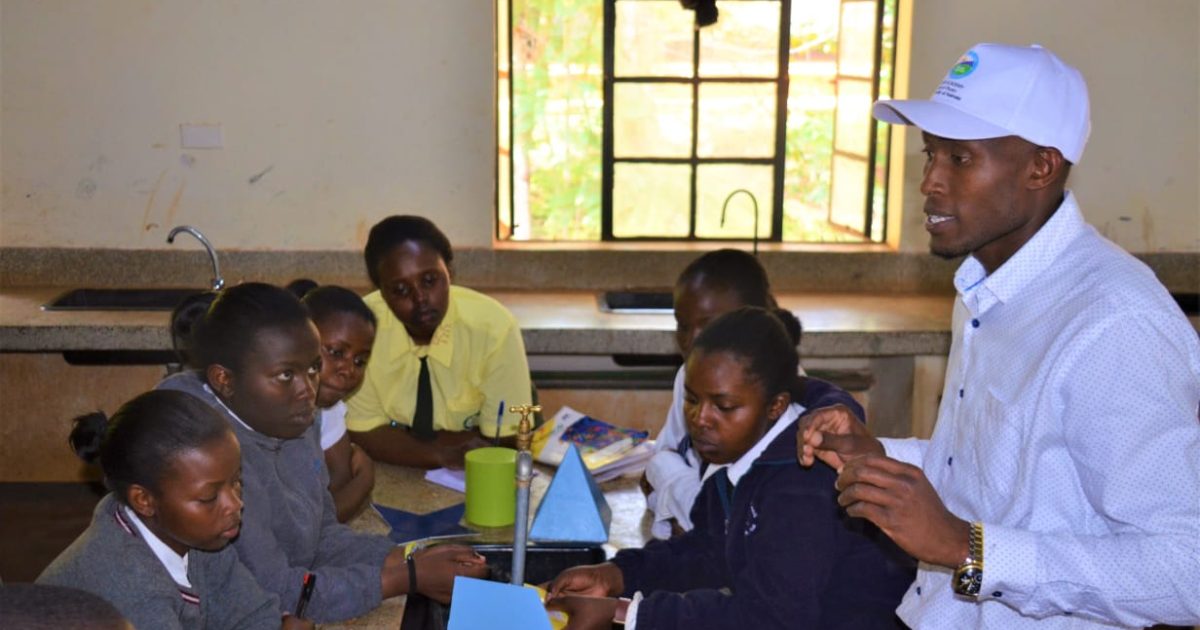
CEMASTEA Brings Top Global Scientists to Kenya as Students Get Rare STEM Career Exposure.
The Centre for Mathematics, Science and Technology Education in Africa (CEMASTEA), in collaboration with the African School of Fundamental Physics and Applications (ASP), has hosted a science outreach programme at Machakos Girls High School aimed at promoting Science, Technology, Engineering and Mathematics (STEM) education among secondary school learners.
The programme brought together students from schools in Machakos County and leading scientists and lecturers from the United States, Switzerland, Europe and Asia to provide mentorship, scientific demonstrations and career guidance, with a focus on physics and its applications in engineering, renewable energy, technology and research.
Speaking during the outreach programme, CEMASTEA Coordinator for Junior and Senior School Programmes Philip Maate said the partnership with ASP had created an opportunity for learners to interact with internationally recognised scientists and lecturers pursuing advancements in science and technology.
“The partnership has made it possible to bring together leading scientists and lecturers from the United States, Switzerland, Europe and Asia who have excelled in this field to engage directly with students and future engineers pursuing STEM pathways, particularly physics,” said Maate.
Maate stated that the initiative had expanded access to STEM mentorship by bringing together learners from neighbouring schools in Machakos County, enabling more students to explore the role of physics in addressing global challenges, including renewable energy development.
He noted that the interactions between students and experienced scientists were expected to strengthen interest in science, technology and innovation careers.
Increased STEM Participation Among Learners
CEMASTEA reported increased interest in STEM subjects following the introduction of its outreach programmes, with more learners enrolling in science pathways and participating in science and engineering competitions.
Maate observed that the number of girls pursuing STEM subjects, particularly physics, had increased significantly, describing the development as an important step toward improving gender representation in science education.
“The landscape has changed. STEM pathways are no longer the preserve of boys. We are seeing an increasing number of girls taking STEM subjects, especially physics, and actively participating in science and engineering competitions. This is the direction we want to strengthen,” he said.
The outreach programme forms part of CEMASTEA’s continued efforts, together with its partners, to develop scientific talent, encourage innovation and equip young people with skills required to contribute to Kenya’s future science and technology sectors.
Expansion of STEM Outreach to Junior Schools
CEMASTEA indicated that the programme would be expanded beyond secondary schools in Machakos County to reach learners at the grassroots level, including junior schools.
According to Maate, the initiative will incorporate access to a virtual laboratory designed to support STEM learning and experimentation among learners across different regions.
The centre stated that the virtual platform would assist in addressing resource limitations by enabling students to participate in practical science learning regardless of their geographical location.
The programme combines international scientific expertise, local mentorship and digital learning tools as part of efforts to strengthen Kenya’s pipeline of future scientists, engineers and innovators.
ASP Conducts Ninth Biennial Physics Outreach Programme in Africa
Professor Christine Darve of Sweden, a member of the International Organizing Committee of the African School of Fundamental Physics and Applications (ASP), said the Machakos outreach programme marked the organisation’s ninth biennial initiative aimed at promoting physics education across Africa.
The programme, which is conducted every two years, focuses on engaging young learners and increasing awareness of the importance of physics in everyday applications and scientific development.
Prof. Darve stated that physics plays a critical role in understanding and advancing other disciplines, including mathematics, biology and computer science.
She noted that developing a strong foundation in physics was essential in preparing future engineers, researchers and innovators.
The ASP programme also includes capacity-building initiatives for teachers, who play a central role in guiding learners and promoting interest in science subjects.
Prof. Darve said strengthening teachers’ knowledge and teaching approaches would enhance their ability to inspire students and support scientific learning.
She commended Kenyan students for their discipline, enthusiasm and curiosity, noting that learners participating in the programme demonstrated strong interest in scientific exploration.
Teachers Support STEM Mentorship Initiative
Harrison Ndingili, a Physics and Chemistry teacher at Machakos Girls High School and an alumnus of the ASP programme, said the outreach initiative had positively influenced learners, particularly students pursuing physics.
Ndingili stated that the programme had exposed students to various career opportunities while demonstrating practical applications of scientific concepts.
“The students really enjoyed the hand-crank generator demonstration that converts mechanical energy into electrical energy using electromagnetic induction, and we fully welcome this initiative. It will help young learners to excel,” Ndingili said.
He added that participation in such programmes had contributed to increased motivation among female learners pursuing STEM subjects, particularly physics.
Students Gain Exposure to Scientific Applications
The outreach programme featured practical demonstrations and scientific sessions that enabled learners to connect classroom concepts with real-world applications.
Yvonne Mumbua, a 16-year-old student at Machakos Girls High School, said the physics demonstrations strengthened her interest in the subject and influenced her career aspirations.
During the programme, Yvonne interacted with a Van de Graaff generator demonstration, which illustrated the principles of electrostatic charge, electric fields and energy transfer.
She stated that the practical experience enabled her to understand how physics concepts apply beyond classroom learning and contribute to technological innovation.
“I’ve always loved physics because it helps explain how things work. After seeing the demonstrations, I realised those problem-solving skills can also help me become a software engineer,” she said.
Yvonne indicated that her interest in physics had expanded to include computer programming, with plans to pursue software engineering.
Kelvin Kamau, a 16-year-old student at Kathiani Boys Senior School, said the programme demonstrated the relationship between physics and other scientific disciplines.
He noted that physics principles were applicable in areas such as mathematics, biology, engineering and technology.
“What stood out to me is that physics is applied everywhere. It’s not just equations on a board. It’s in how things work,” Kelvin said.
Kelvin stated that the experience had strengthened his ambition to pursue engineering and apply scientific knowledge in developing solutions to real-world challenges.
Dennis Oloo, a Form Three student at Mumbuni High School, said learning about particle accelerators during the outreach programme had expanded his understanding of the relationship between physics and medicine.
The student was introduced to applications of particle accelerators in medical diagnosis, cancer treatment, medical imaging and scientific research.
“I’ve always wanted to become a doctor, but I didn’t know physics played such an important role in healthcare. Learning about particle accelerators has shown me how science and medicine work together to improve people’s lives,” Dennis said.
He stated that the programme had motivated him to strengthen his performance in physics and other science subjects as he pursues his ambition of joining the medical profession.
Elsewhere, Parliament to Summon Secondary School Principals Over Billions in Public Funds
Conclusion
The CEMASTEA and ASP STEM outreach programme continues to provide learners with exposure to global scientific expertise, practical demonstrations and mentorship opportunities aimed at strengthening participation in science, technology, engineering and mathematics pathways.
The initiative targets the development of future scientists, engineers, researchers and innovators through enhanced STEM engagement, teacher capacity building and expanded access to practical learning resources.
CEMASTEA Brings Top Global Scientists to Kenya as Students Get Rare STEM Career Exposure.
Follow Teachers Updates on Facebook, LinkedIn, X (Twitter), WhatsApp, Telegram, and Instagram. Get in touch with our editors at hello@teachersupdates.news.
