

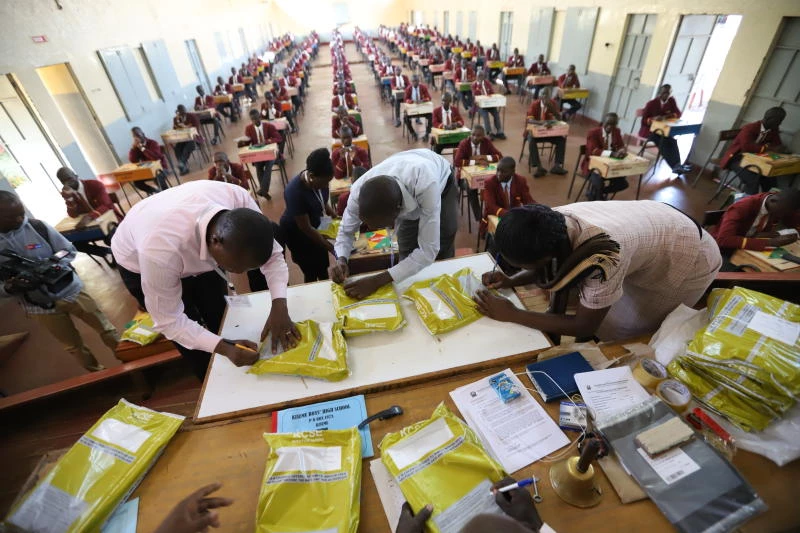
Eight Months Later: Thousands of Teachers Still Waiting for Their Exam Money.
Thousands of teachers who supervised and marked Kenya’s 2025 national examinations and assessments are yet to receive their examination allowances more than eight months after completing the assignments, despite assurances by the National Treasury that the payments would be settled before the close of the 2025/2026 financial year.
The prolonged delay has escalated into a labour dispute, with teachers’ unions warning that members may boycott Kenya National Examinations Council (KNEC) training sessions, examination invigilation, supervision and marking for the 2026 national examinations unless the outstanding payments are released.
Treasury Commitment Yet to Be Honoured
During the presentation of the 2026/2027 Budget Statement on June 11, 2026, National Treasury and Economic Planning Cabinet Secretary John Mbadi informed Parliament that Sh1.5 billion had been allocated to settle pending examination allowances owed to teachers before the end of the 2025/2026 financial year on June 30, 2026.
Earlier, National Assembly Budget and Appropriations Committee Chairperson Samuel Atandi had announced that the funds had been provided under Supplementary Estimates II specifically to facilitate payment of examination supervisors, invigilators and other personnel engaged during the 2025 national examinations.
However, the June 30 deadline elapsed without payments being effected.
A senior Kenya National Examinations Council (KNEC) official, speaking on condition of anonymity, indicated that the Council had not received the funds from the National Treasury.
The official stated that KNEC could only process payments after receiving the allocated funds, noting that payment would have been effected immediately upon receipt of the money.
Thousands of Teachers Remain Unpaid
The delayed payments affect teachers who participated in administering the following national examinations and assessments during the 2025 examination cycle:
- Kenya Certificate of Secondary Education (KCSE)
- Kenya Primary School Education Assessment (KPSEA)
- Kenya Junior School Education Assessment (KJSEA)
The affected personnel include supervisors, invigilators, centre managers and examiners responsible for administering and marking the examinations across the country.
Budget Constraints Behind the Delays
Budget documents indicate that KNEC required Sh12.7 billion to administer the 2025 national examinations during the 2025/2026 financial year.
However, the Council received only Sh5.9 billion under the original budget allocation.
According to the budget documents:
- KNEC funding requirement: Sh12.7 billion
- Original allocation: Sh5.9 billion
- Additional allocation through Supplementary Estimates II: Sh3.1 billion
- Outstanding funding gap: approximately Sh4.76 billion
More than Sh1 billion from the original allocation was reportedly utilised to settle pending obligations arising from the previous examination cycle, leaving insufficient resources to finance the current year’s examination operations.
Teachers Express Frustration Over Delayed Allowances
Teachers affected by the delayed payments have expressed dissatisfaction over the prolonged wait despite repeated government assurances.
Ogoro Miruka, a teacher at Lang’ata West Primary School, said he supervised both KPSEA and KJSEA examinations for twelve days at a daily allowance of Sh500, but had not received any payment.
He stated that despite repeated promises, including the assurance that payments would be made by June 30, 2026, no funds had been released.
Another primary school teacher, who requested anonymity, stated that delayed payments had significantly reduced teachers’ willingness to participate in future examination exercises.
The teacher noted that previous examination allowances had traditionally been paid shortly after the release of examination results but that no payments had been made for the 2025 assignments despite numerous government commitments.
She further indicated that many teachers travelled long distances to their examination centres and encountered difficult working conditions while undertaking the assignments.
Evans Ochieng’, a teacher at Riruta Satellite Junior School, stated that some examination markers were also yet to receive their full payments.
He argued that waiting almost a year to receive examination allowances was unacceptable and called for a review of the existing remuneration rates, stating that the current allowances do not correspond with the workload involved.
Teachers’ Unions Issue Boycott Threats
The delayed payments have prompted strong reactions from teachers’ unions.
Kenya Union of Post Primary Education Teachers (KUPPET) Deputy Secretary-General Moses Nthurima described the eight-month delay as unacceptable.
He stated that the government should ensure timely financing of examination activities, warning that failure to adequately support critical education functions could undermine the quality of education.
Kenya National Union of Teachers (KNUT) Second National Vice-Chairperson Hesbon Otieno stated that union officials had engaged National Treasury Cabinet Secretary John Mbadi before the presentation of the national budget, during which assurances were given that payments would be released.
He said the prolonged delay was unacceptable and called upon the government to establish a sustainable mechanism for timely payment of examination personnel.
KNUT Nairobi Executive Secretary Mugwe Macharia stated that members had increasingly contacted union offices seeking intervention over the unpaid allowances.
He warned that if the outstanding payments were not released, the union would advise members not to attend KNEC training sessions in preparation for the 2026 national examinations and would consider discouraging them from accepting examination invigilation assignments.
Macharia further stated that teachers were questioning the continued acceptance of examination responsibilities while payments remained delayed and daily allowances remained low.
KNUT Murang’a South Executive Secretary Njata John similarly stated that teachers felt betrayed after fulfilling their examination responsibilities.
He noted that funds for examination personnel had already been budgeted for, yet teachers remained unpaid, adding that the union would oppose members’ participation in KNEC meetings and training activities until the outstanding allowances were settled.
Potential Impact on the 2026 National Examinations
The dispute has raised concerns regarding preparations for the 2026 national examination cycle.
Kenya’s national examinations rely on tens of thousands of teachers serving in various capacities, including:
- Examination supervisors
- Invigilators
- Centre managers
- Examiners
- Markers
Any large-scale withdrawal of teachers from these assignments could affect examination preparation, administration and marking, requiring KNEC to identify alternative personnel within limited timelines.
Read Also: KNEC Issues Urgent July 30 Deadline for All Schools
The dispute has also renewed concerns regarding the level of remuneration provided for examination duties, with teachers noting that allowances of Sh500 per day for some assessment assignments are insufficient to cover transport and related expenses, particularly for personnel deployed away from their home stations.
As the 2026 national examination cycle approaches, the release of the outstanding examination allowances remains a central issue in discussions between teachers, their unions, the National Treasury and the Kenya National Examinations Council.
Eight Months Later: Thousands of Teachers Still Waiting for Their Exam Money.
Follow Teachers Updates on Facebook, LinkedIn, X (Twitter), WhatsApp, Telegram, and Instagram. Get in touch with our editors at hello@teachersupdates.news.
